

Every Powder Mixing machine works in its own way. Each one has good points and bad points. Some powder mixing machine can mix big batches fast. Others mix gently to protect soft materials. Picking the right machine helps companies make better products. It also helps them save time and money. Thinking about each machine’s pros and cons gives better results. This is true for any mixing job.
Key Takeaways
- Ribbon mixers mix powders softly and evenly. They can handle big batches and many powder types.
- Drum mixers are easy to use and work well. They are gentle and best for powders that flow easily. They work best for small or medium batches.
- Double cone mixers mix soft powders gently and evenly. They need more space and take longer to work.
- Stainless steel flat mixers are strong and simple to clean. They save energy and are good for dry or a little wet powders.
- High speed dispersing mixers mix powders and liquids very fast. They break up lumps but use more power. They need careful use.
- Three-dimensional mixers mix very evenly with gentle movement. They are good for soft powders and different batch sizes.
- Picking the right mixer depends on powder type and batch size. It also depends on how easy it is to clean, space, cost, and safety rules.
- Cleaning and taking care of mixers often keeps them working well. This also keeps products safe, especially in food and medicine.
Ribbon Mixer

Principle
A ribbon mixer has a long, flat container. Inside, there are two helical ribbons on a spinning shaft. The outer ribbon moves powder one way. The inner ribbon moves it the other way. This makes the powder mix gently and well. The main way it mixes is by convection. The ribbons lift and toss the powder to spread it out. Studies using DEM show convection is most important for mixing. The design works for many kinds of powders. The shape of the powder does not change how well it mixes. This makes the ribbon mixer a good choice for many jobs.
Advantages
- The blades move in opposite ways for gentle, even mixing.
- The mixer lasts a long time because it is made of stainless steel.
- It is easy to use with controls you can program.
- Two ribbons spin fast to mix powder quickly.
- The mixer is sealed, so powder does not leak out.
- It is easy to clean and fix because of its simple parts.
- It can mix small or large amounts, from 5 to 25,000 liters.
- DEM tests show it works well with different powder shapes.
- Wider blades help mix better and faster.
- It can handle many batch sizes and powder types.
Tip: Ribbon mixers can mix up to 94.13% evenly if you mix for 13 minutes and fill the tank to about half. They can be 85.7% efficient when mixing 30 kg per hour in each batch.
Disadvantages
- Some powder may not mix if the tank is too full or too empty.
- The spokes that hold the blades can change how well it mixes.
- More spokes can make the powder press together more, especially with loose powders.
- Some spoke shapes and low fill levels can slow down mixing.
- Workers need to set up the spokes and speed just right to avoid problems.
| Operational Metric | Description/Value |
|---|---|
| Homogeneity Coefficient | Up to 94.13% at best settings |
| Mixing Time | 10 to 13 minutes |
| Tank Filling Level | About half full is best |
| Efficiency | 85.7% (cross-ribbon mixer, 30 kg/hr per batch) |
A ribbon mixer works best if you watch the fill level, blade speed, and blade shape. These things help the Powder Mixing machine work well every time.
Applications
Ribbon mixers are used in many businesses. They can mix lots of different powders and grains. Their design lets them mix gently but still very well. This is why both big factories and small companies like to use them.
Key Industries Using Ribbon Mixers:
- Food Industry:
Ribbon mixers blend things like flour, spices, and baking powders. They also mix drink powders and instant soups. Food companies use them to make even mixes for cake mixes and protein powders. They also help with seasoning blends. The gentle mixing keeps soft ingredients from breaking. - Pharmaceuticals:
Many drug companies use ribbon mixers for powders in tablets and capsules. They also use them for supplements. The mixer makes sure each batch is mixed the same way. This is important for safety and for the medicine to work right. - Chemical Industry:
Ribbon mixers mix fertilizers, detergents, and pigments. They also mix plastic powders. The machine can handle both tiny and bigger pieces. This helps chemical companies make products that are all the same. The closed design stops dust and keeps things clean. - Cosmetics and Personal Care:
Companies use ribbon mixers for face powders and bath salts. They also use them for other beauty items. The gentle mixing keeps special ingredients safe. It also helps the powder stay smooth. - Animal Feed and Agriculture:
Ribbon mixers mix vitamins, minerals, and grains for animal food. Farmers and feed makers use them to make sure animals get the right food every time.
Note: Ribbon mixers work best with dry powders that flow easily. Sticky or wet stuff may not mix as well.
Common Products Made with Ribbon Mixers:
| Industry | Example Products |
|---|---|
| Food | Cake mix, spice blends, flour |
| Pharmaceuticals | Tablet powders, supplements |
| Chemicals | Fertilizers, detergents, pigments |
| Cosmetics | Face powder, bath salts |
| Animal Feed | Grain blends, vitamin mixes |
Ribbon mixers can be used for special recipes too. Workers can change how long and how fast they mix. This helps make new products faster.
Some factories use ribbon mixers to mix things before sending them to other machines. Others use them as the main mixer for finished products. Because they can mix small or big batches, ribbon mixers are a good choice for many companies.
Drum Mixer
Principle
A drum mixer mixes powders by spinning a drum. The drum sits on rollers or an axle. It turns at a steady speed. When the drum spins, the powders inside tumble and roll. This movement helps mix the powders together. Mixing happens in batches, not all the time. Workers put the right amount of powder in the drum. They start the drum and let it spin for a set time. After mixing, they stop the drum and take out the mixed powder. Drum mixers work best with materials like cement, sand, or dry powders.
Advantages
- Drum mixers are simple, so they are easy to use and fix.
- They can mix small or big batches, from 50 to 100 gallons.
- The gentle tumbling helps protect soft particles from breaking.
- Workers can use drum mixers for many kinds of powders and grains.
- The closed drum keeps dust inside and the area cleaner.
- Drum mixers do not need fancy controls or lots of power, so they save energy.
- Mixing in batches lets workers check quality between mixes.
Drum mixers are good for jobs that do not need fast or strong mixing. Many companies pick them because they are reliable and not expensive.
Disadvantages
- Drum mixers may not mix as evenly as some other Powder Mixing machines, especially with powders of different sizes or weights.
- Mixing takes longer than with fast or special mixers.
- Because they mix in batches, workers must stop and start the machine for each load, which can slow down work.
- Cleaning the drum can take a while, especially if sticky powders are used.
- Drum mixers may not work well with thick materials or very fine powders that stick together.
- Studies show static mixers can save more energy and keep powders mixed better than drum mixers.
- Drum mixers may let some powders move apart during mixing, which can change the final product.
Workers should think about the powder type, batch size, and mixing needs before picking a drum mixer. The best choice depends on the job and the material.
Applications
Drum mixers are used in many industries. Their simple shape and gentle mixing make them popular. Companies pick drum mixers to blend dry powders or small grains. These mixers do not break the powders.
Industries That Use Drum Mixers:
- Construction:
Drum mixers mix cement, sand, and dry mortar. Workers use them on building sites for concrete and plaster. The mixer keeps the mix even and ready. - Food Processing:
Food companies use drum mixers for flour, sugar, spices, and baking mixes. The gentle tumbling keeps soft ingredients safe. This helps the food keep its texture and taste. - Pharmaceuticals:
Drum mixers blend powders for tablets and capsules. They help make sure each pill has the right amount of medicine. The closed drum keeps powders clean and safe. - Chemicals:
Chemical plants use drum mixers for dry chemicals, fertilizers, and pigments. The mixer can handle both small and big batches. This makes it useful for many chemical products. - Agriculture:
Farmers and feed makers use drum mixers for animal feed, seeds, and supplements. The mixer helps each batch mix the same way.
Tip: Drum mixers work best with powders that flow easily. Sticky or very fine powders may not mix well.
Common Products Made with Drum Mixers:
| Industry | Example Products |
|---|---|
| Construction | Cement, mortar, plaster |
| Food | Baking mixes, spice blends |
| Pharmaceuticals | Tablet powders, supplement blends |
| Chemicals | Fertilizers, pigments, detergents |
| Agriculture | Animal feed, seed blends |
Drum mixers help with research and new product testing. Scientists use them to try new powder mixes in small batches. The batch process lets them change recipes and check results fast.
Some companies use drum mixers to pre-mix before using other machines. Others use them as the main mixer for finished products. The closed drum keeps dust inside and the area clean.
Drum mixers are flexible and reliable for mixing many powders. Their simple use and gentle mixing make them a good choice for many jobs.
Double Cone Mixer
Principle
A Double Cone Mixer has a vessel shaped like two cones joined together. The vessel spins around to mix powders and granules. As it turns, the materials inside tumble and slide on the smooth walls. This gentle movement helps mix the powders without breaking them. The design helps most of the powder move, so there are fewer spots where nothing happens. Workers can put baffles or deflector plates inside to help mix better. These are useful for powders that need more movement. The Double Cone Mixer mixes in batches. Workers can change the speed and time to get the best mix.
Advantages
- The Double Cone Mixer mixes gently, so it protects soft materials.
- Its shape helps mix powders and granules evenly with few dead spots.
- The mixer can handle many types of powders and granules, so it is useful for many jobs.
- You can take parts off to clean them, which helps stop mixing batches from getting mixed up.
- It can mix faster than some other Powder Mixing machines, especially if you use baffles or deflectors.
- Workers can change how much powder goes in and how fast it spins to fit different jobs.
- The closed vessel keeps dust inside, so the work area stays clean and safe.
The Double Cone Mixer is good for mixing soft or delicate powders. Many companies use it when they need gentle and even mixing.
Disadvantages
- The Double Cone Mixer’s shape can make mixing from end to end slow. Axial mixing is slower than mixing in each half of the mixer.
- If there are no baffles or deflectors, it may take longer to mix, especially if the powder does not flow well.
- Because it mixes in batches, workers must load and unload it each time, which can slow down big jobs.
- Some powders might stick to the smooth walls, so cleaning can be hard if not done right away.
- The mixer is not great for sticky or wet powders because they can clump and not mix well.
- The mixer is big and needs enough space, so it may not fit in small rooms.
| Limitation | Description |
|---|---|
| Axial Mixing Rate | Slower than mixing in each half; baffles can help |
| Cleaning | Easy for most powders, harder for sticky ones |
| Batch Operation | Slower for very big jobs |
| Space Requirement | Needs enough room to work safely |
Workers can add deflector plates that do not move to help mix faster from end to end and get an even mix sooner.
Applications
The Double Cone Mixer is used in many industries. It mixes powders gently and well. Its special shape and slow turning help with soft materials. Many companies pick this mixer to stop their products from breaking.
Industries That Use Double Cone Mixers:
- Pharmaceuticals:
Drug makers use Double Cone Mixers for tablet and capsule powders. The gentle mixing keeps important parts safe. This helps each pill have the right medicine amount. The closed mixer keeps powders clean and blocks dust. - Food Processing:
Food companies use these mixers for dry things like flour, cocoa, and spices. The mixer helps keep food taste and feel the same. It also blends vitamins and minerals into healthy foods. - Chemical Industry:
Chemical plants use Double Cone Mixers for powders and pigments. The mixer can mix both small and big pieces. It helps make each batch the same every time. - Cosmetics and Personal Care:
Cosmetic makers use Double Cone Mixers for face powders and bath salts. The gentle mixing keeps special parts safe. This helps the final product stay smooth and soft. - Metals and Ceramics:
Some factories use Double Cone Mixers for metal and ceramic powders. The mixer helps make even mixes for parts or tiles.
Tip: Double Cone Mixers work best with powders that flow easily. Sticky or wet things may not mix as well.
Common Products Made with Double Cone Mixers:
| Industry | Example Products |
|---|---|
| Pharmaceuticals | Tablet blends, supplement powders |
| Food | Baking mixes, spice blends |
| Chemicals | Pigments, specialty powders |
| Cosmetics | Face powder, bath salts |
| Metals/Ceramics | Metal powder blends, ceramic mix |
Many labs use Double Cone Mixers to test new powder mixes. The batch process lets scientists try new recipes and check results. This helps them make new products faster.
Some companies use Double Cone Mixers before other machines. Others use them as the main mixer for finished goods. The mixer’s design fits many jobs.
Double Cone Mixers help companies make safe, good products. Their gentle mixing keeps parts whole and spread out. This makes them a smart pick for many powder mixing jobs.
Stainless Steel Flat Mixer
Principle
A stainless steel flat mixer has a flat blade inside a strong tank. The blade spins and moves powder from one side to the other. This helps spread the powder all through the tank. The flat shape lets the mixer reach most of the powder. This means there are not many spots where powder stays still. The mixer can go at different speeds. Workers can pick the speed that fits the powder type. The stainless steel body keeps powder safe from rust or harm. Many companies use this mixer for dry and a little wet powders.
Advantages
Stainless steel flat mixers have many good points for factories and labs. The strong steel body does not rust or get hurt by chemicals. This makes the mixer last a long time, even with lots of use. The flat blade mixes powder fast and evenly. Workers can clean the mixer easily because the inside is smooth. The mixer can handle heat well, which helps with powders that need heat control.
Stainless steel mixers help save energy. They use up to 20% less energy than mixers made from other stuff. Good insulation and smart controls help use less power. This saves money and helps the planet.
The table below shows how stainless steel is different from other mixer materials:
| Material | Corrosion Resistance | Durability | Heat Conductivity | Cost Effectiveness |
|---|---|---|---|---|
| Stainless Steel | High | Excellent | High | Moderate |
| Cast Iron | Low | Good | Moderate | Low |
| Copper | Moderate | Fair | High | High |
Many businesses, like food and drug makers, pick stainless steel flat mixers. These mixers keep powders clean and safe. They also help control heat, which is important for good products. The mixer’s design helps blend powders the same way every time.
- Stainless steel mixers lower repair costs over time.
- They last long, so companies do not replace them often.
- They work well with green energy, so they are good for eco-friendly factories.
Disadvantages
Stainless steel flat mixers have some downsides. They cost more at first than iron or plastic mixers. Some powders may stick to the flat blade, which can slow mixing. Workers need to check the mixer often to make sure all powder moves. The mixer is heavy, so it needs a strong floor and enough room. Some models use more power if they run fast for a long time.
Workers should pick the right size and speed for the job. This helps stop problems and keeps mixing working well.
Some powders that are very sticky or clump may not mix well in a flat mixer. In these cases, another mixer might work better. Cleaning often is important to keep the mixer working and stop powder from building up.
Applications
Stainless steel flat mixers are used in many fields. They are strong and easy to clean. This makes them a good pick for mixing powders. Many companies use these mixers to keep products safe and clean.
Industries That Use Stainless Steel Flat Mixers:
- Food Processing:
Food factories use these mixers for flour, sugar, cocoa, and spices. Workers also mix baking mixes and instant drink powders. The stainless steel keeps food safe from rust and germs. - Pharmaceuticals:
Drug makers use flat mixers for tablet and capsule powders. The smooth inside stops powder from sticking. This keeps each batch pure and easy to clean. - Chemical Industry:
Chemical plants use these mixers for dry chemicals, pigments, and detergents. The mixer can handle small and big batches. Stainless steel stands up to strong chemicals, so it lasts longer. - Cosmetics and Personal Care:
Companies mix face powders, bath salts, and body scrubs in these mixers. The mixer helps keep colors and smells the same in every batch. - Animal Feed and Agriculture:
Feed mills use these mixers for vitamins, minerals, and grains. The mixer makes sure animals get the right mix of nutrients.
Tip: Stainless steel flat mixers work best with dry or a little damp powders. Sticky or very wet powders may not mix well.
Common Products Made with Stainless Steel Flat Mixers:
| Industry | Example Products |
|---|---|
| Food | Cake mix, spice blends, cocoa |
| Pharmaceuticals | Tablet powders, supplement blends |
| Chemicals | Detergents, pigments, fertilizers |
| Cosmetics | Face powder, bath salts |
| Animal Feed | Grain blends, vitamin mixes |
Many labs use stainless steel flat mixers to test new powder blends. The mixer’s design lets workers change recipes and check results fast. This helps companies make new products quicker.
Some factories use these mixers before sending powders to other machines. Others use them as the main mixer for finished goods. The flat blade helps mix powders evenly, so every batch is good.
Stainless steel flat mixers help companies save time and money. They are easy to clean and strong, so they are a smart choice for many jobs.
High Speed Dispersing Mixer
Principle
A high speed dispersing mixer has a blade that spins very fast. The blade pulls powders and liquids to the middle. Then it pushes them out to the sides. This breaks up clumps and spreads the powder everywhere. The mixer works best if the tank is clean. The blade should fit the tank well. Workers use the highest safe speed for good mixing. The mixer can mix thick or sticky stuff because the blade moves so fast. Many factories use this mixer when they need quick and even mixing.
Advantages
High speed dispersing mixers have many good points. They mix powders and liquids much faster than most other mixers. The strong blade breaks up lumps and makes the mix smooth. Many businesses use these mixers to save time and make better products. Paint, coatings, adhesives, and drug companies all use them.
New technology like automation and real-time checks make these mixers better. They now use less energy and make less waste. This helps companies spend less money.
A new report shows how these mixers help different jobs:
| Industry Sector | Improvement Metric | Percentage Improvement | Impact Description |
|---|---|---|---|
| Chemical Production | Product throughput increase | 20% | Faster processing and higher profits |
| Paint and Coatings | Reduction in mixing time | 35% | Lower labor and energy costs |
| Pharmaceutical | Waste reduction | 25% | Less material waste and quicker returns |
These numbers show that high speed dispersing mixers help companies work faster and better.
These mixers work for many kinds of jobs. Lab dispersers can spin up to 30,000 rpm. This is great for mixing paint, glue, and ceramics. Inline dispersers are even faster. They help make clean or air-free products for drug companies.
Disadvantages
High speed dispersing mixers have some problems too. They use a lot of power, especially at high speeds. This can make energy bills go up if used for a long time. The strong blade can heat up the mix. This is not good for powders that do not like heat. Workers must watch the mixer to stop it from getting too hot or hurting the product.
Some powders may not mix well if the blade or tank is the wrong size. The mixer can splash or make dust if not covered right. Cleaning the mixer can take a while, especially with sticky stuff. The fast blade can be dangerous if workers do not follow safety rules.
Workers should always check the blade, tank, and speed before mixing. Using the right setup helps stop problems and keeps everyone safe.
High speed dispersing mixers work best when used with care and the right steps. They are strong machines, but workers must use them carefully to get good results.
Applications
High speed dispersing mixers are important in many industries. These machines help mix powders and liquids fast and evenly. Their quick blades break up lumps and spread everything in the tank. Many factories use them to make products that need smooth mixing.
Industries That Use High Speed Dispersing Mixers:
- Paint and Coatings:
Paint factories use these mixers for pigments, resins, and solvents. The mixer helps the paint get the right color and feel. It also keeps the paint smooth and stops clumps. - Adhesives and Sealants:
Glue and sealant companies use these mixers. The mixer helps mix thick and sticky materials. It makes sure glue spreads well and sticks right. - Pharmaceuticals:
Drug makers use these mixers for powders and liquids in medicine. The mixer helps make creams, gels, and suspensions. It keeps each batch safe and even. - Cosmetics and Personal Care:
Cosmetic companies use these mixers for lotions, creams, and makeup. The mixer blends colors and smooths the texture. It also mixes powders into liquids for things like foundation. - Food and Beverage:
Food factories use these mixers for drink powders, sauces, and flavors. The mixer helps powders dissolve fast. It also keeps the mix smooth and tasty. - Chemicals:
Chemical plants use these mixers for detergents and cleaning agents. The mixer helps mix powders and liquids that do not blend easily.
Tip: High speed dispersing mixers are best for jobs needing fast, even mixing. They help save time and make products better.
Common Products Made with High Speed Dispersing Mixers:
| Industry | Example Products |
|---|---|
| Paint | Wall paint, automotive coatings |
| Adhesives | Glue, sealants |
| Pharmaceuticals | Creams, gels, suspensions |
| Cosmetics | Lotions, liquid makeup |
| Food | Drink powders, sauces |
| Chemicals | Detergents, cleaning agents |
Many labs use these mixers to test new recipes. The mixer lets scientists try different speeds and times. This helps them find the best way to mix each product.
Some companies use these mixers at the start of making a product. Others use them to finish mixing before packaging. The mixer’s speed and power make it a top pick for many jobs.
Note: Always check the mixer’s speed and blade size first. The right setup helps get the best results and keeps products safe.
Three-Dimensional Mixer
Principle
A three-dimensional mixer moves in a special way to mix powders. The drum spins in more than one direction at once. This makes the powders lift, tumble, and fold together. The powders move all around, not just in a circle. This helps every part of the mix blend well. The design stops powder from staying in one spot. Workers can change how fast and at what angle the drum spins. This lets them match the mixer to different jobs and batch sizes. Many factories use this mixer when they need very even mixing.
Advantages
Three-dimensional mixers have many good points for labs and factories. The main benefit comes from how the drum moves. The mixer’s motion helps powders mix fast and evenly. This gives a very even final product. The gentle tumbling keeps soft particles from breaking. The mixer works with both small and big batches. Workers can use it for powders, granules, and some small pellets.
- The mixer mixes faster than old-style tumblers.
- It can handle many types of materials, even hard-to-mix ones.
- The closed drum keeps dust inside and the area clean.
- Many models are easy to load and unload, which saves time.
- The mixer is simple to use and does not need fancy controls.
Many businesses like drug, chemical, and food companies use three-dimensional mixers. These mixers help make better products and keep things the same every time. New mixing technology like this helps companies meet tough rules and keep quality high.
A new study found a three-dimensional mixer could mix almost 100% in ongoing jobs. The simple design makes it easy to build and use in many factories.
Disadvantages
Three-dimensional mixers also have some downsides. The way they work can cause problems in some cases. How well it mixes depends on the drum’s angle and speed. If the slope is low, the mixer may not blend as well. The table below shows how mixing changes with different settings:
| Parameter / Condition | Quantitative Value / Observation | Implication / Disadvantage |
|---|---|---|
| Standard deviation (σ) at 40° slope | 6.51 | Higher σ means less even mixing at lower angles |
| Standard deviation (σ) at 80° slope | 2.44 | Lower σ means better mixing at higher angles |
| Critical diameter at 60° slope angle | ~778 μm | Powders smaller than this may not mix well due to surface tension |
| Mixing time for efficient mixing | 12 seconds (3 cycles) | Takes longer than some other mixers |
| Limitations on liquid types | Only suitable for water–water mixing | Cannot mix alcohol-based liquids |
| Fabrication surface quality | Unsmooth inside surface from 3D printing | Can affect mixing performance and cleaning |
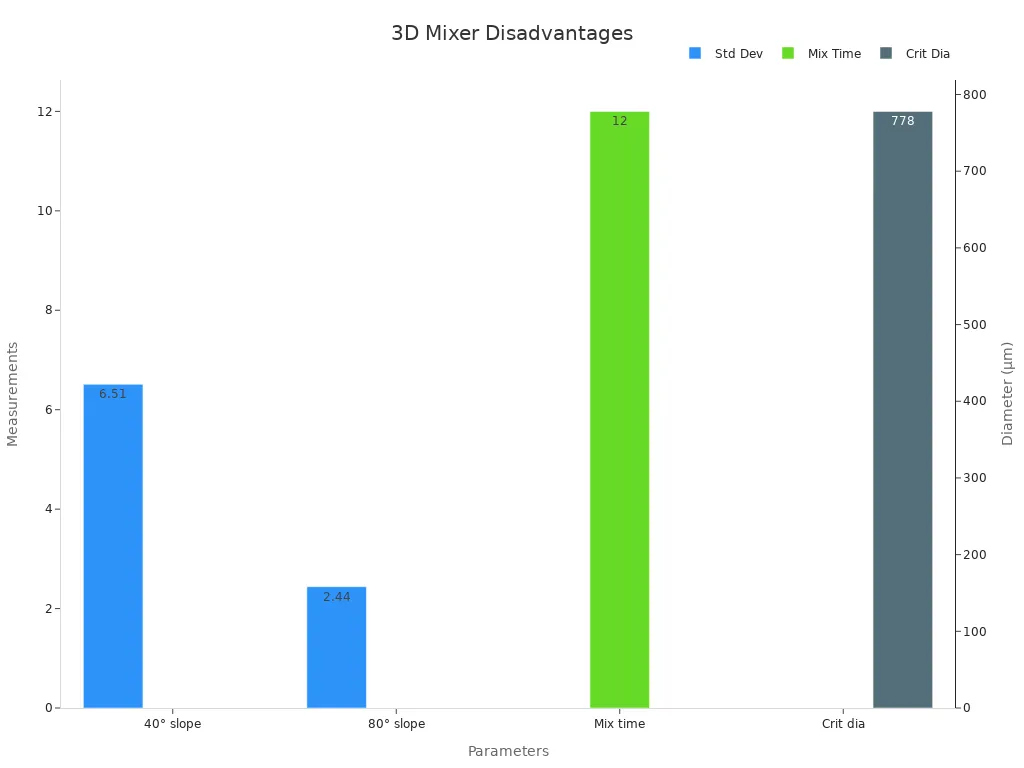
The mixer may not work well with very fine or sticky powders. Some mixers have rough insides, which makes cleaning harder. The mixer cannot handle all types of liquids. It works best with water-based mixes, not alcohol-based ones. Workers should check powder size and type before picking this mixer.
Picking the right mixer helps companies get the best results. Three-dimensional mixers are good for many jobs, but workers should know their limits with some powders or liquids.
Applications
Three-dimensional mixers are used in many industries that need careful powder mixing. Their special movement helps companies get good results with both small and big batches. Many businesses pick these mixers when they do not want to break soft particles or when they need a very even mix.
Industries That Use Three-Dimensional Mixers:
- Pharmaceuticals:
Drug makers use three-dimensional mixers to blend powders for tablets and capsules. The gentle tumbling keeps important ingredients safe. Each batch stays the same, which is important for medicine safety and quality. - Food and Beverage:
Food companies use these mixers for things like instant drink powders, spice mixes, and supplements. The mixer helps keep flavors and nutrients spread out evenly. This makes sure every serving tastes the same. - Chemicals:
Chemical plants use three-dimensional mixers for pigments, special powders, and additives. The mixer’s movement stops clumps and helps make even products. This matters for paints, plastics, and cleaners. - Cosmetics and Personal Care:
Cosmetic companies mix face powders, bath salts, and body care items with these mixers. The gentle action keeps sensitive ingredients safe. The result is a smooth, high-quality product. - Metals and Ceramics:
Factories that make metal or ceramic parts use three-dimensional mixers to mix fine powders. The even mixing helps make strong, reliable parts for electronics, tools, and tiles.
Tip: Three-dimensional mixers work best with dry powders that flow easily. Sticky or very wet materials may not mix well.
Common Products Made with Three-Dimensional Mixers:
| Industry | Example Products |
|---|---|
| Pharmaceuticals | Tablet blends, supplement powders |
| Food | Drink mixes, spice blends |
| Chemicals | Pigments, specialty additives |
| Cosmetics | Face powder, bath salts |
| Metals/Ceramics | Powder blends for parts |
Many research labs use three-dimensional mixers too. Scientists test new recipes and formulas in small batches. The mixer’s design lets them change how long and how fast they mix. This helps them find the best way to make each new product.
Some companies use these mixers for final mixing before packing. Others use them to get powders ready for more steps. The closed drum keeps dust inside, so the workspace stays clean and safe.
Three-dimensional mixers help companies meet tough quality rules. Their even mixing and gentle action make them a smart pick for many powder mixing jobs.
Powder Mixing Machine Selection
Material Properties
Picking the right Powder Mixing machine starts with knowing your powders. Powders come in many sizes and shapes. Some are light and move easily. Others are sticky or have big grains. These things change how well a mixer works. Gentle mixers like double cone or V-blenders are best for soft or free-flowing powders. High shear mixers work better for sticky or clumpy powders.
Scientists found that things like particle size and surface energy matter. How easy a powder slides or rolls also changes mixing. If a powder does not move well, it may not mix evenly. Some mixers, like ribbon mixers, can mix many kinds of powders. Others need powders that flow easily. Companies often test powders before picking a mixer. This helps make sure the final product is good.
Tip: Always pick a mixer that matches the powder’s flow and size. This helps stop clumps and uneven mixing.
Batch Size
Batch size is important when picking a mixer. Some mixers are best for big batches. Others work better for small or changing amounts. Ribbon mixers can mix very big batches, even over 10,000 liters. Tumbler or V-blenders are good for small and medium batches. In-bin blending systems let companies mix different batch sizes in containers.
Mixers that handle both small and big batches give more choices. This helps companies that make many products or change recipes a lot. But bigger mixers can take longer to load, mix, and clean. Companies should think about how much they need to make at once. They should pick a mixer that fits their needs.
| Mixer Type | Best Batch Size | Flexibility |
|---|---|---|
| Ribbon Mixer | Large (hundreds to >10,000 L) | High |
| V-Blender | Small to Medium | Moderate |
| In-bin Blender | Small to Large | Very High |
Cleaning & Maintenance
Cleaning and taking care of mixers is very important. It helps mixers work well and keeps products safe. Some mixers, like V-blenders, are easy to clean because of their simple shape. This stops old powder from mixing with new batches. Ribbon mixers have more parts and can be harder to clean. If not cleaned well, leftover powder can cause problems.
Cleaning and maintenance help mixers last longer. Experts say that with good care, mixers can last 10-20 years or more. Workers check and clean parts like blades and shafts. This stops powder from building up and keeps the mixer running well. Using real parts and following a cleaning plan helps stop breakdowns and repairs.
Note: Mixers that are easy to clean save time and help stop cross-contamination. This is very important for food and drug companies.
Space & Cost
Space and cost are important when picking a Powder Mixing machine. Factories need to check how much space they have first. Some mixers, like ribbon or drum mixers, take up a lot of room. Other mixers, like three-dimensional mixers, fit in smaller spaces. The mixer’s size also changes how easy it is to move or set up.
Cost is more than just buying the mixer. Companies must think about running, cleaning, and fixing costs too. Some mixers use more electricity, so bills can go up. Some mixers need special parts or tools for repairs. Stainless steel mixers cost more at first, but last longer and break less.
Tip: Always measure your space before you buy a mixer. This helps stop problems when you set it up.
The table below shows how mixers compare for space and cost:
| Mixer Type | Space Needed | Initial Cost | Running Cost | Maintenance |
|---|---|---|---|---|
| Ribbon Mixer | Large | Medium | Medium | Low |
| Drum Mixer | Medium | Low | Low | Low |
| Double Cone Mixer | Large | High | Medium | Medium |
| Stainless Steel Flat | Medium | High | Low | Low |
| High Speed Dispersing | Small | Medium | High | Medium |
| Three-Dimensional Mixer | Small | Medium | Low | Low |
Companies should think about space and cost together. A small factory may pick a small mixer, even if it costs more. A big factory may get a bigger mixer to save money per batch.
Safety & Regulations
Safety and rules are very important when picking a powder mixer. Factories must follow rules to keep workers and products safe. Some industries, like food and medicine, have strict safety rules. These rules help stop accidents and keep products clean.
Experience shows that safety rules affect which mixer is picked. Factories must choose mixers that meet food safety and quality rules. The right mixer helps keep powder clean and mixed well. This keeps the final product safe for people.
Note: Always check local and industry rules before buying a mixer. This helps stop fines and keeps the company’s good name.
Some mixers have safety features like covers, emergency stops, and dust control. These features help keep workers safe. Companies should teach workers to use mixers safely and clean them the right way.
A good Powder Mixing machine should meet all safety and quality rules. This keeps workers and customers safe.
Comparison Table

It is easier to pick a Powder Mixing machine when you can compare them side by side. The table below shows how each mixer works, what is good about it, and what is not so good. This helps people find the mixer that fits their job.
| Mixer Type | Mixing Principle | Advantages | Disadvantages |
|---|---|---|---|
| Ribbon Mixer | Forced shear stirring | Can mix big batches, mixes well, easy to use, saves money, simple to run | May leave some powder, can have spots that do not mix, needs a lot of power to start |
| Drum Mixer | Gravity tumbling | Simple shape, gentle on soft pieces, easy to use, cheap, keeps dust inside | Takes longer to mix, may not mix all powders the same, cleaning can take longer |
| Double Cone Mixer | Gravity convection diffusion | Mixes gently, keeps soft things safe, no spots where powder stays still, good for big jobs | Not as fast, takes more time to mix, not good for sticky powders |
| Stainless Steel Flat Mixer | Forced shear with flat blade | Strong, lasts long, easy to clean, does not rust, keeps heat steady, uses less energy | Costs more at first, heavy, some powders may stick, needs a strong floor |
| High Speed Dispersing Mixer | High-speed blade dispersion | Mixes very fast, breaks up lumps, good for thick or sticky stuff, saves time | Uses a lot of power, can make mix hot, needs careful setup, harder to clean |
| Three-Dimensional Mixer | Multi-directional tumbling | Mixes very evenly, gentle on soft powders, works for many batch sizes, keeps dust inside | Takes longer to mix, uses more power, not for very fine or sticky powders, size can limit use |
Tip: Each mixer is best for certain powders and batch sizes. Factories should pick a mixer that matches what they need.
This table gives a quick look at the mixers. Ribbon mixers and stainless steel flat mixers are good for big, regular jobs. Drum and double cone mixers are better for gentle mixing. High speed dispersing mixers are best when you need to mix fast. Three-dimensional mixers are great for even mixing, especially for soft powders.
A Powder Mixing machine should match the powder, how much you need to mix, and how easy it is to clean. Looking at these things helps companies choose the best mixer.
Every mixer has good and bad points. Companies need to pick a Powder Mixing machine that fits their material, batch size, cleaning, and budget. The table below shows which mixer works best for each need:
| Factor / Mixer Type | Ribbon Blender | Vertical Blender | Tumble Blender |
|---|---|---|---|
| Material Properties | Wide range | Gentle, small | Fragile, free-flowing |
| Batch Size | Large | Small | Limited |
| Mixing Time | Efficient | Quick, gentle | Gentle, low heat |
| Space Constraints | More space | Compact | Moderate |
| Cleaning & Maintenance | Moderate | Easy | Easy |
Scientists learned that changing how mixers are built or used can help powders mix better in medicine. If a company has tricky needs, they can ask experts, try out samples, or talk to suppliers. Picking the right mixer helps companies get better mixes and makes work easier.
FAQ
What is the best powder mixer for large batches?
Ribbon mixers work well for large batches. They handle high volumes and mix powders evenly. Many factories choose them for their speed and flexibility.
How often should workers clean powder mixing machines?
Workers should clean machines after each batch. Regular cleaning keeps products safe and prevents cross-contamination. Some industries require strict cleaning schedules.
Can one mixer handle both dry and wet powders?
Some mixers, like high speed dispersing mixers, can handle both dry and wet powders. Others, such as ribbon mixers, work best with dry materials.
Are powder mixing machines safe to use?
Most modern mixers include safety features like covers and emergency stops. Workers should always follow safety rules and wear protective gear.
How do workers choose the right mixer for their product?
Workers look at powder type, batch size, cleaning needs, and cost. They match these needs to the mixer’s strengths. Testing samples helps find the best fit.
Do all mixers need a lot of space?
Not all mixers need much space. Three-dimensional mixers and high speed dispersing mixers fit in smaller areas. Ribbon and double cone mixers usually need more room.
What maintenance do powder mixers require?
Workers check blades, shafts, and seals regularly. They replace worn parts and keep the machine clean. Good maintenance helps mixers last longer and work better.